



























Skip to content
Smart Data
An elevated highway in Tokyo at night

Modern data platforms

Data engineering consulting for analytics and AI

We build the pipelines, warehouse layers and reporting that finance, operations and AI all read from, on Microsoft Fabric, Databricks or Snowflake. Old and new run side by side until the numbers match.

Where it starts

Problems you’ve probably lived with

  • Reporting

    Sales, finance and operations report three different revenue numbers.

    Each team builds its number from its own extract. We define it once, upstream, so every report reads the same one.

    Start with: the numbers people argue about, and where each one comes from.

  • Spreadsheets

    Our best analysts fix the same spreadsheet every month.

    The cleanup happens by hand because nothing upstream does it. We move it into the platform, where it runs on every load.

    Start with: the manual fixes that repeat every month.

  • Integration

    Every new report turns into another integration project.

    When each source lands once in the platform, a new report reads what is already there instead of needing its own pipeline.

    Start with: the sources behind your most requested reports.

  • Upgrades

    An ERP upgrade breaks every dashboard downstream.

    Dashboards wired straight to the ERP break when it changes. With layers in between, the change is absorbed once instead of in every report.

    Start with: the dashboards that read your ERP directly.

Our data services

Where most data engineering work begins

Data engineering work usually starts from something already running: SSIS packages, Azure Data Factory pipelines, a SQL Server or Oracle warehouse and the reports built on them.

Data architectureFor analytics, streaming and AI

Data engineering and architecture

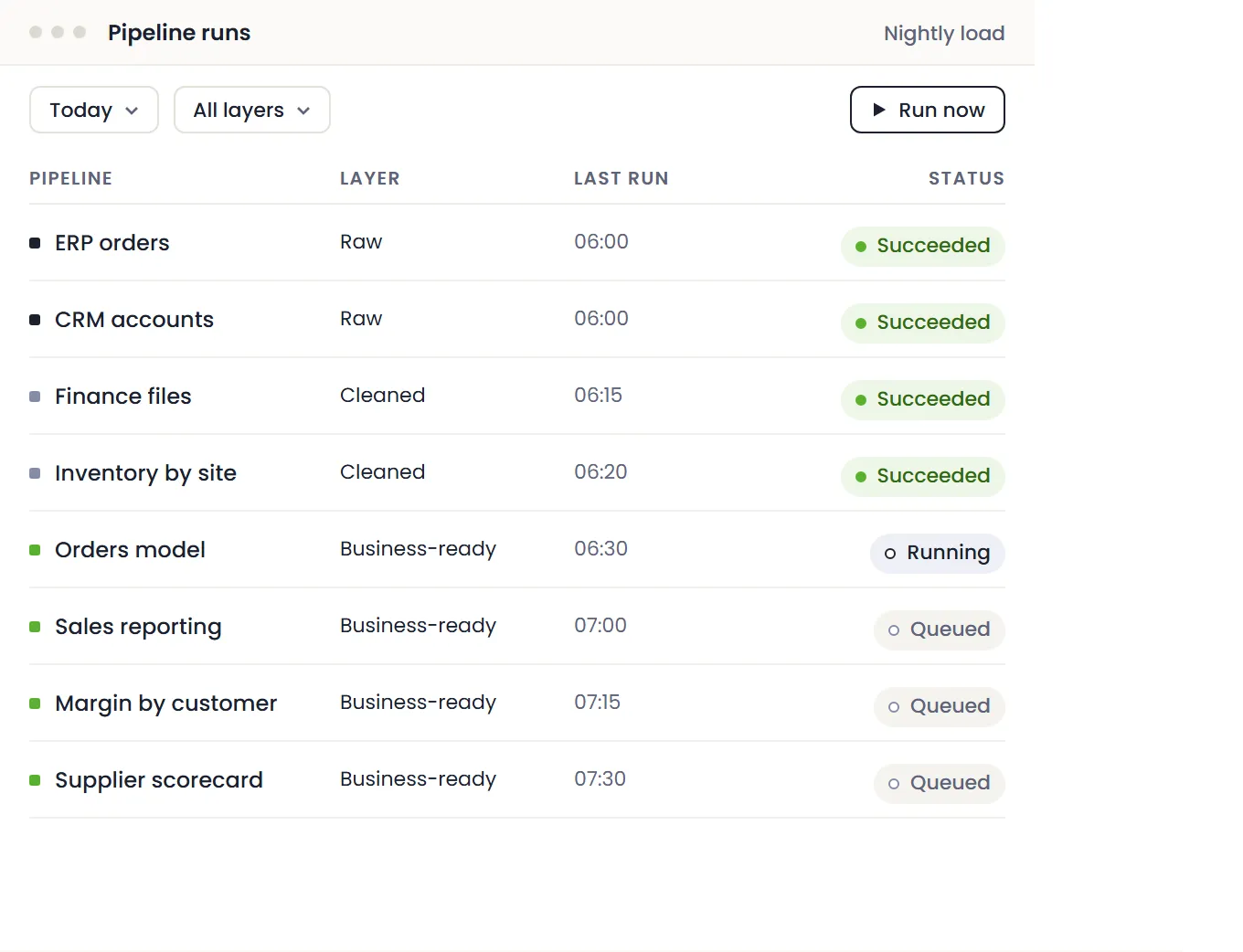
We build in Bronze, Silver and Gold layers: a raw copy of every source, a layer where trust gets built and business-ready data that dashboards and AI read. Each transformation is built once and serves every consumer.

  • Modern data lakehouse and warehouse design
  • Real-time data architecture for streaming and event-based use cases
  • Batch and stream processing
  • Apache Kafka
  • Apache Spark
  • Airflow
  • dbt
  • Microsoft Fabric
  • Databricks
Cloud data migrationsOld and new run in parallel

Cloud and platform data migrations

We move warehouses and pipelines to Azure, AWS or Google Cloud and run the old and new side by side until the numbers match, so reporting keeps running through the move.

  • Migration sequencing and cutover plans
  • Platform-specific migrations (AWS, Azure, GCP)
  • Hybrid and multi-cloud strategies
  • Azure Data Factory
  • Microsoft Fabric
  • Databricks
  • Snowflake
  • SSIS
How a retailer moved legacy ETL to Databricks
Serverless data pipelinesNo servers to run or patch

Serverless data pipelines

For event-driven loads we build pipelines on Lambda, Step Functions, Azure Data Factory and Dataflow, so there are no servers to patch and compute is billed only while data is moving.

  • Right-sized workflows, billed per run
  • Cloud-native orchestration (AWS Lambda, Azure Data Factory, GCP Dataflow)
  • Infrastructure as Code (IaC) and CI/CD for data
  • AWS Lambda
  • Azure Data Factory
  • Snowflake
  • Python
Data quality and governanceQuality rules and lineage in the pipeline

Data quality and governance

Quality rules, lineage and access controls go into the pipelines themselves, so an audit question has an answer in the platform and a bad load is caught before it reaches a dashboard.

  • Validation, de-duplication and reconciliation checks on every load
  • Controls mapped to HIPAA and GDPR requirements
  • Metadata and lineage tracked from source system to report
  • Microsoft Purview
  • Unity Catalog
  • SQL and T-SQL
  • Data auditing
Analytics and BIDashboards through predictive modeling

Analytics and business intelligence

Power BI, Tableau or Looker on governed semantic models, so finance and operations read the same number from the same definition.

  • Embedded BI and reporting (Power BI, Tableau, Looker)
  • Predictive analytics and forecasting models
  • Executive dashboards and self-service analytics
  • Power BI
  • SQL and T-SQL
  • SSIS
  • Python

If you’re not sure where to start, the first call sorts that out.Talk to us about scope

How we build it

Build it once and serve every consumer

Land the raw data, clean it once and publish the version people and AI models can rely on. The pattern works the same on Microsoft Fabric, Databricks or Snowflake. For most companies already on Microsoft, Fabric is the affordable place to start.

  • Bronze

    A raw copy of every source. Keep the evidence, so a mistake in your logic doesn’t become a permanent mistake in your history.

  • Silver

    Where trust gets built: cleaned, checked and conformed into one definition of each number.

  • Gold

    Business-ready data that dashboards, analysts and AI read.

  • Where to start

    Pick your most valuable sources, stand up the layers and put the effort into Gold. One Gold use case in 90 days, not a full warehouse rebuild.

AI Enablement GuideA guide from Smart Data

How this connects to AI

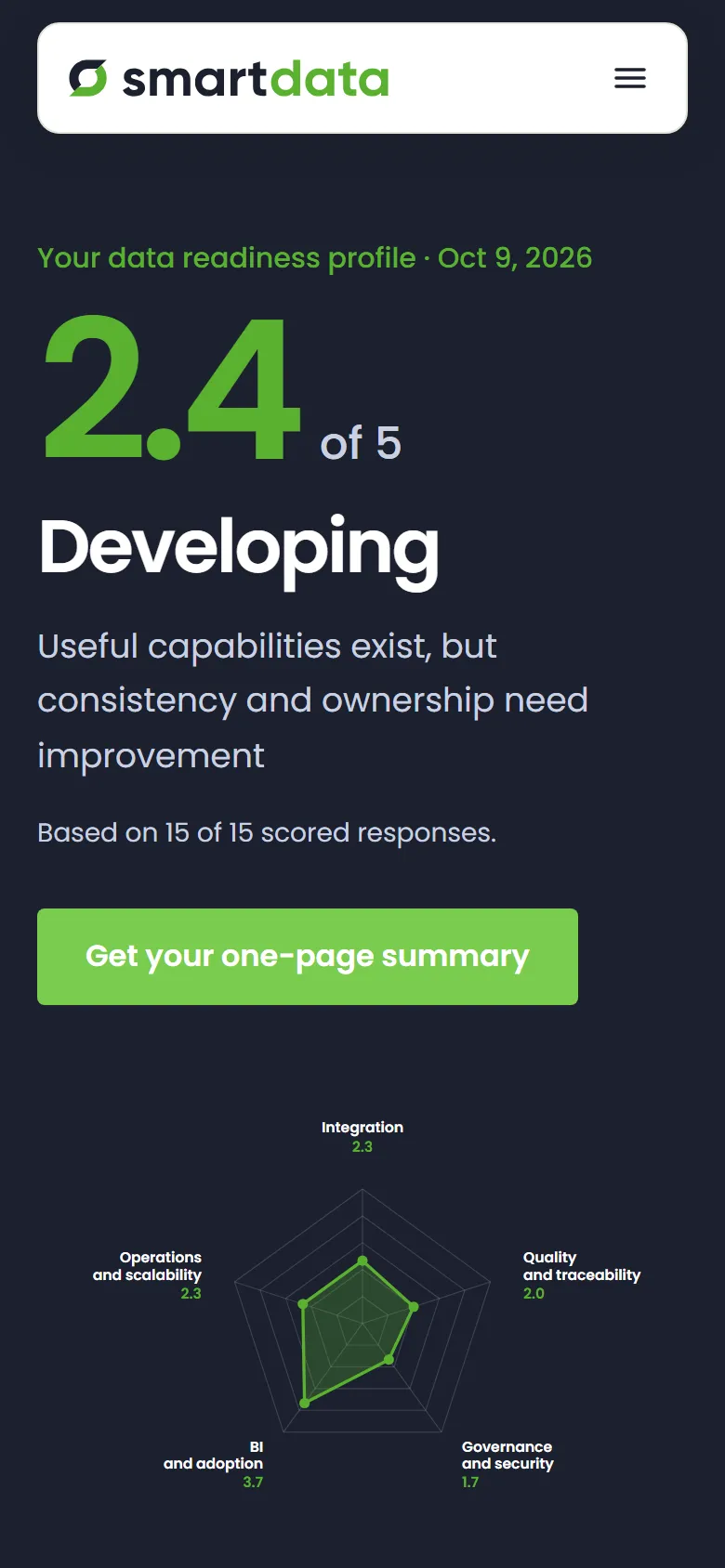
Not sure your data is ready for AI?

The AI Enablement Guide shows how platform modernization connects to AI readiness.

How we deliver

From first review to a platform your team runs

A defined path from understanding the estate to a platform your organization can use and support.

  1. 01

    01Understand and design

    Review the estate and agree the architecture, first workload and responsibilities.

    Deliverable

    An architecture and first-workload plan, with owners named on both sides.

  2. 02

    02Implement and validate

    Build the pipelines and models, and check the results against the business needs.

    Deliverable

    Working pipelines and models, validated against the checks the business agreed.

  3. 03

    03Operate and improve

    Hand the platform to your team, or keep our engineers on to support it.

    Deliverable

    Runbooks and a documented handover, or an ongoing support plan.

Scoped projects, staff augmentation or managed support after launch.See how we deliver

Industries

Industries we work in

NOV18Wednesday, 2026Taste of ITDAYTON

Taste of IT · November 18

See the medallion architecture live

Chris St. Amand and Chad Puterbaugh on “Wrangling Your Data with the Medallion Architecture.” Bronze keeps every source raw, Silver builds trust and Gold feeds dashboards, analysts and AI, on Fabric, Databricks or Snowflake. Prizes in bronze, silver and gold.

21 days away

Meet us there

A few practical questions

Work through the decisions

Questions we hear on first calls.

Ask us about your situation
What approach works for data migration?

We start with the business process, then the technology. Map data lineage and dependencies, define data quality rules before moving anything, build incremental pipelines so old and new systems can run in parallel, and validate at every stage with automated testing. We phase the work so each step is validated and can be rolled back.

What does AI-ready data mean in practice?

Data that is clean, governed, accessible and structured for AI to use: consistent formats across systems, documented lineage, quality monitoring with automated alerts and governed access. You can start before the data is perfect, as long as you know which data is trustworthy and build from there.

How do you justify ROI for early data engineering work?

It comes from three places: lower cost from consolidating redundant systems and automating manual work, recovered revenue ($16M+ in lost Medicaid revenue came back to a health plan after our team noticed a nursing facility file was mishandling records), and a shorter path from data to decision. Name the measurable outcomes before starting.

Which platform should our data engineering run on?

It depends on your existing stack, your team and how you want to pay for compute. For most companies already on Microsoft, Fabric is the affordable place to start: engineering and Power BI on one capacity, with governance and security included. Databricks is the better fit for heavy engineering, streaming and machine learning, and works alongside Fabric when the work outgrows it. Snowflake works well for SQL teams that want little to administer and need to share governed data. We build on all three.

Next step

Which pipelines need to hold up next year?

Tell us what feeds your reporting today and what has to change. Here is what happens after you reach out.

  1. A short call about your sources, pipelines and platform

    What runs today, where it breaks and what the business needs from it.

  2. An engineer looks at what’s running

    Scope comes from your systems as they are, before anything is priced.

  3. You get a written proposal

    Covering scope, team, approach and price.

info@smartdata.net(937) 886-9166

Tell us what you are working on

We use your details only to reply.

Your privacy choices

Choose what this browser shares with us. The site works the same either way. Privacy policy