AI Enablement Guide

Most AI Investments Fail. Yours Doesn't Have To.

This is a practical guide to AI enablement and ai development services, built on 2026 research from PwC, Deloitte, Anthropic, Snowflake, Databricks, and others. Not vendor opinions. Not anecdotal advice. Published data from surveys covering tens of thousands of executives and practitioners, cited with links so you can verify every claim.

This is a practical guide to AI enablement and ai development services, built on 2026 research from PwC, Deloitte, Anthropic, Snowflake, Databricks, and others. Not vendor opinions. Not anecdotal advice. Published data from surveys covering tens of thousands of executives and practitioners, cited with links so you can verify every claim.

This is a practical guide to AI enablement and ai development services, built on 2026 research from PwC, Deloitte, Anthropic, Snowflake, Databricks, and others. Not vendor opinions. Not anecdotal advice. Published data from surveys covering tens of thousands of executives and practitioners, cited with links so you can verify every claim.

Smart Data

April 2026

18 min read

The Problem

The 56% Problem

PwC's 29th Global CEO Survey asked 4,454 CEOs across 95 countries about AI returns. The finding that should reshape every AI conversation at the leadership level: 56% report neither revenue nor cost benefits from their AI investments.

Not disappointing returns. Not "below expectations." Neither revenue nor cost benefits. Two years running.

56%

of CEOs report zero financial return from their AI investments

Source: PwC 2025 Global CEO Survey

56%

of CEOs report zero financial return from their AI investments

Source: PwC 2025 Global CEO Survey

Meanwhile, Deloitte's State of AI in the Enterprise found that only 25% of organizations have moved 40% or more of their AI experiments into production. Three out of four enterprises are stuck in pilot mode, running experiments that never become operational systems.

Capgemini's Top Tech Trends of 2026 frames the shift directly: "Technology leadership in 2026 is no longer about experimentation but about constructing durable foundations." The models are not the problem. GPT-5.4, Claude, Gemini, Snowflake Cortex, and Microsoft Foundry are genuinely capable systems. The technology works. What does not work is deploying it on top of data that is not ready to support it.

This guide breaks down why AI initiatives fail, what data-ready companies do differently, and how to evaluate whether your organization is positioned to generate real returns from ai implementation services and AI enablement investments.

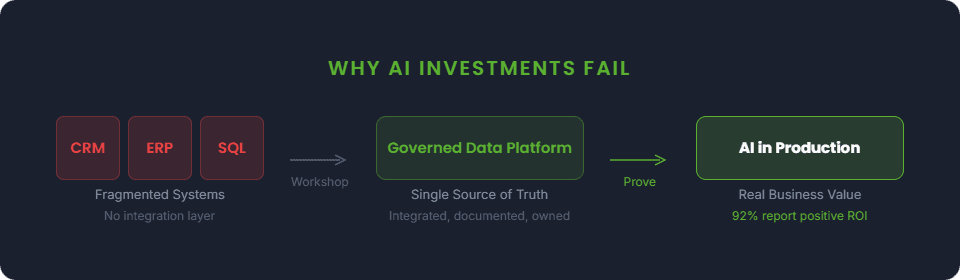
Am image showing "Why AI Investments Fail", showing the path between Fragmented Systems, to a sinlge source or truth, and into AI in Production

The Symptoms

Does This Sound Familiar?

If you are a CTO, VP of Engineering, or data leader at a mid-market or enterprise organization, you have probably encountered at least one of these.

Your Data Lives in Six Places, Connected by None of Them

Customer records in Salesforce. Operational data in an ERP. Financial data in a legacy SQL Server warehouse. Product telemetry in a separate analytics database. Each system tells part of the story. No system tells the whole story.

Your Pipelines Move Data, but Nobody Can Vouch for Its Accuracy

ETL processes that have not been audited in years. Duplicates nobody has cleaned. Stale records from a migration three systems ago. Broken transforms that produce numbers everyone has learned to work around.

Three Departments Define "Customer" Three Different Ways

Marketing counts leads. Finance counts contracted accounts. Operations counts active users. When the AI model asks "how many customers do we have?" the answer depends on which system it queries.

Nobody Can Trace a Number Back to Its Source

A dashboard shows a revenue figure. Someone asks where it came from. The answer involves four handoffs, two manual spreadsheets, and a pipeline nobody has touched since the person who built it left.

The Symptoms

Does This Sound Familiar?

If you are a CTO, VP of Engineering, or data leader at a mid-market or enterprise organization, you have probably encountered at least one of these.

Your Data Lives in Six Places, Connected by None of Them

Customer records in Salesforce. Operational data in an ERP. Financial data in a legacy SQL Server warehouse. Product telemetry in a separate analytics database. Each system tells part of the story. No system tells the whole story.

Your Pipelines Move Data, but Nobody Can Vouch for Its Accuracy

ETL processes that have not been audited in years. Duplicates nobody has cleaned. Stale records from a migration three systems ago. Broken transforms that produce numbers everyone has learned to work around.

Three Departments Define "Customer" Three Different Ways

Marketing counts leads. Finance counts contracted accounts. Operations counts active users. When the AI model asks "how many customers do we have?" the answer depends on which system it queries.

Nobody Can Trace a Number Back to Its Source

A dashboard shows a revenue figure. Someone asks where it came from. The answer involves four handoffs, two manual spreadsheets, and a pipeline nobody has touched since the person who built it left.

The Symptoms

Does This Sound Familiar?

If you are a CTO, VP of Engineering, or data leader at a mid-market or enterprise organization, you have probably encountered at least one of these.

Your Data Lives in Six Places, Connected by None of Them

Customer records in Salesforce. Operational data in an ERP. Financial data in a legacy SQL Server warehouse. Product telemetry in a separate analytics database. Each system tells part of the story. No system tells the whole story.

Your Pipelines Move Data, but Nobody Can Vouch for Its Accuracy

ETL processes that have not been audited in years. Duplicates nobody has cleaned. Stale records from a migration three systems ago. Broken transforms that produce numbers everyone has learned to work around.

Three Departments Define "Customer" Three Different Ways

Marketing counts leads. Finance counts contracted accounts. Operations counts active users. When the AI model asks "how many customers do we have?" the answer depends on which system it queries.

Nobody Can Trace a Number Back to Its Source

A dashboard shows a revenue figure. Someone asks where it came from. The answer involves four handoffs, two manual spreadsheets, and a pipeline nobody has touched since the person who built it left.

The Pattern

What Data-Ready Companies Actually Do Differently

The companies generating real returns from AI are not using better models. They are not spending more. They are doing something much less exciting but far more effective: investing in the data foundation for AI before they invest in the AI itself.

This does not mean waiting years to "get the data perfect." Perfection is not the goal. Readiness is.

Here is what readiness looks like in practice.

42%

cite data quality requirements as the top barrier to scaling AI agents

Anthropic Logo

Source: Anthropic State of AI Agents Report, 500+ technical leaders

42%

cite data quality requirements as the top barrier to scaling AI agents

Anthropic Logo

Source: Anthropic State of AI Agents Report, 500+ technical leaders

  1. They Assess Before They Build

Before selecting an AI use case, data-ready companies assess their actual data environment. Where does the data live? What is the quality? What is documented and what is tribal knowledge? Where are the gaps between what exists and what the intended AI use case requires?

This is the step most enterprises skip. The assumption is "we have data, so we can do AI." But having data and having data that can support a specific AI use case are fundamentally different things.

The Anthropic State of AI Agents Report surveyed 500+ technical leaders and found that 42% cite data quality requirements as the top barrier to scaling AI agents. Not model capability, not compute costs, not talent shortages. Data quality. An AI readiness assessment takes two to three weeks. Skipping it can cost six to twelve months of wasted effort when the pilot stalls on data problems that could have been identified upfront.


Not sure where your organization stands?

Our 360 AI Workshop maps your data landscape and identifies realistic AI use cases in 2-3 weeks

Not sure where your organization stands?

Our 360 AI Workshop maps your data landscape and identifies realistic AI use cases in 2-3 weeks

  1. They Build the Integration Layer First

The companies seeing returns connected their data sources into a governed, reliable platform before deploying AI on top of it. The specific platform matters less than the principle: one governed source of truth that AI models can trust.

Without this layer, every AI project becomes a data wrangling project with a model attached. Fivetran's enterprise benchmark found that 97% of enterprises report disruptions to AI or analytics initiatives from data infrastructure gaps, with pipeline downtime costing an average of $49,600 per hour in business impact.

Data engineering and platform modernization are not prerequisites you can shortcut. They are the data foundation for AI that determines whether it delivers business value or just runs up cloud bills.


  1. They Prove Value on Real Data, Not Demo Data

A proof of concept that runs on sample data proves nothing about production viability. Data-ready companies build their proofs of value on actual production data, including all its messiness, edge cases, and volume.

A model that performs well on a curated 10,000-row sample will behave very differently when it hits two million rows of production data with missing fields, inconsistent formatting, and edge cases nobody anticipated. If the proof of value holds against real data, it will hold in production. If it only works on a curated sample, it will fail when it encounters the operational environment.

A team looking at a white board planning the data foundation for their company.
  1. They Design for Production from Day One

A model running in a Jupyter notebook is not a deployed AI system. Production AI requires monitoring, governance, retraining schedules, error handling, and a team that understands how to maintain it over time.

The companies generating returns from AI treated production deployment as a first-class concern from the start. They planned for how the model would be monitored, who would own retraining, what happens when inputs drift, and how errors would surface and get resolved. The companies that did not plan for production built impressive demos that never made it past the pilot phase.

Deloitte calls this "pilot fatigue." From their State of AI in the Enterprise report: "If there is no coherent AI strategy in organizations, you are likely to see pilot fatigue. Without a clear roadmap, executing a hundred pilots just leads to poor results and failed value creation."

This is where ai development services differ from a proof of concept. Building a working prototype is a fraction of the work. Operationalizing it, keeping it accurate, and integrating it into business workflows is where most of the effort (and most of the value) lives.


  1. They Start with Use Cases the Data Can Actually Support

Not every AI use case requires the same data maturity. Document processing and summarization (using retrieval-augmented generation, or RAG) can work with moderate data maturity because the model operates on existing unstructured content. Predictive analytics and forecasting demand much higher maturity because they depend on clean, consistent, historically reliable structured data.

Data-ready companies match their AI ambitions to their current data state. They pick a use case that is realistic given what they have today, deliver value, and then use that momentum (and that improved data infrastructure) to tackle more ambitious projects. Companies that skip this step often start with the most complex, highest-visibility use case and then stall because the data is not there to support it.


  1. They Treat Data Governance as an Ongoing Practice, Not a One-Time Project

Governance is not a box you check before deploying AI. It is an ongoing discipline that ensures data stays reliable as systems, teams, and business logic evolve. Data-ready companies establish clear ownership (who is responsible for each data domain), consistent definitions (what "customer" means across every system), and documented lineage (how data moves from source to dashboard to model).

  1. They Design for Production from Day One

A model running in a Jupyter notebook is not a deployed AI system. Production AI requires monitoring, governance, retraining schedules, error handling, and a team that understands how to maintain it over time.

Deloitte calls this "pilot fatigue." From their State of AI in the Enterprise report: "If there is no coherent AI strategy in organizations, you are likely to see pilot fatigue. Without a clear roadmap, executing a hundred pilots just leads to poor results and failed value creation."

This is where ai development services differ from a proof of concept. Building a working prototype is a fraction of the work. Operationalizing it, keeping it accurate, and integrating it into business workflows is where most of the effort (and most of the value) lives.

  1. They Start with Use Cases the Data Can Actually Support

Not every AI use case requires the same data maturity. Document processing and summarization (using retrieval-augmented generation, or RAG) can work with moderate data maturity because the model operates on existing unstructured content. Predictive analytics and forecasting demand much higher maturity because they depend on clean, consistent, historically reliable structured data.

Data-ready companies match their AI ambitions to their current data state. They pick a use case that is realistic given what they have today, deliver value, and then use that momentum (and that improved data infrastructure) to tackle more ambitious projects. Companies that skip this step often start with the most complex, highest-visibility use case and then stall because the data is not there to support it.

  1. They Treat Data Governance as an Ongoing Practice, Not a One-Time Project

Governance is not a box you check before deploying AI. It is an ongoing discipline that ensures data stays reliable as systems, teams, and business logic evolve. Data-ready companies establish clear ownership (who is responsible for each data domain), consistent definitions (what "customer" means across every system), and documented lineage (how data moves from source to dashboard to model).

12x

more AI projects put into production by companies using AI governance versus those without

Databricks Logo

Source: Databricks State of AI Agents

12x

more AI projects put into production by companies using AI governance versus those without

Databricks Logo

Source: Databricks State of AI Agents

The payoff for treating governance seriously is substantial. According to Databricks' State of AI Agents report, companies using AI governance put over 12x more AI projects into production than those without it. That is not a marginal improvement. It is an order-of-magnitude difference. The same report found that AI governance investment grew 7x in nine months, suggesting that enterprises are beginning to recognize what the data shows: governance is not overhead. It is a production accelerator.

Without governance, even a well-built AI system degrades over time. New data sources get connected without documentation. Definitions drift as teams make local changes. The model outputs slowly become unreliable, and nobody can pinpoint when or why the degradation started. And the risk is not just accuracy. Flexera's 2026 State of the Cloud Report found that 53% of organizations rank security and compliance as their number one cloud concern, ahead of cost and performance. Governance is not just a data quality issue. It is a security issue.
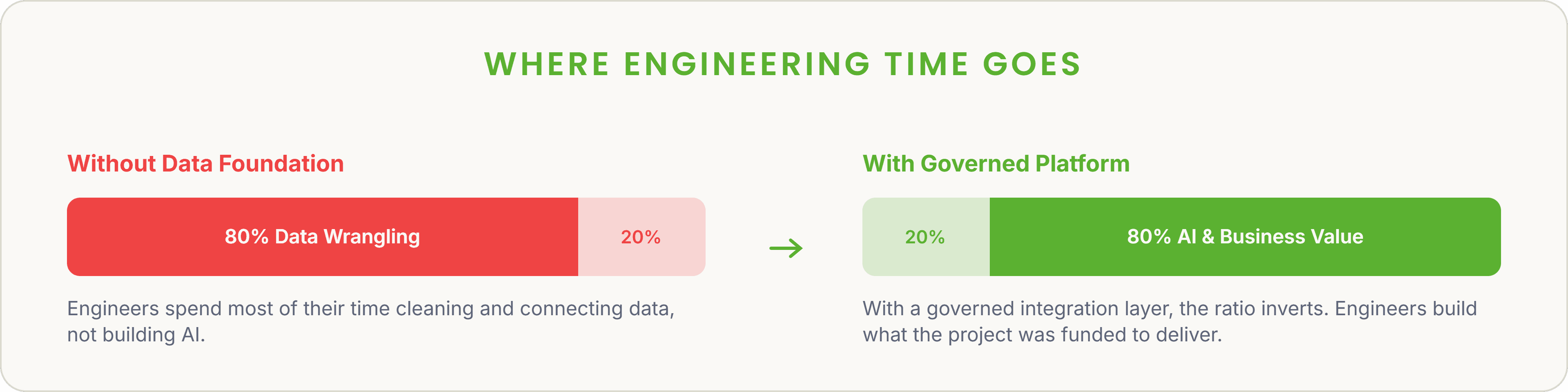
Image showing where engineering time goes, from  Without a Data Foundation to With a Governed Platform

The Framework

AI Use Cases by Data Maturity

Most failed AI pilots share the same root cause: choosing a use case that demands a level of data maturity the organization has not reached. The result is a pilot that works in a controlled environment and fails when it touches real data at scale.

The framework below maps AI use cases to three maturity tiers. It is designed to help you identify where your organization sits today and what is realistic to pursue without months of infrastructure work first.

Low Maturity

Can start now

Medium Maturity

Foundation work needed

High Maturity

Full data foundation required

Low Maturity

You Can Start Now

These use cases work with data as it exists in most organizations because they operate on unstructured content or existing codebases rather than requiring governed, integrated pipelines.

Document search and summarization (RAG). If your organization has policy manuals, product documentation, legal contracts, or technical specifications, a retrieval-augmented generation system can make that content searchable and summarizable. No data pipeline required. The content already exists; the AI layer makes it accessible.

Internal knowledge base Q&A. Similar to document search, but tuned for employee-facing queries. Works with existing wikis, shared drives, email archives, and internal documentation. Particularly effective in organizations where institutional knowledge lives in individual inboxes rather than shared systems.

Code assistance and developer productivity. AI coding assistants operate on existing codebases and do not require any data foundation work. According to Anthropic's 2026 Agentic Coding Trends Report, developers now use AI in roughly 60% of their work, though full delegation remains limited to 0-20% of tasks. The gap between usage and delegation tells you something important: AI accelerates developers who understand the code, but it cannot replace the judgment that comes from understanding the system.

What you need before you start: An inventory of the content or code the AI will access, basic access controls, and a plan for how humans will validate outputs.

Medium Maturity

Some Foundation Work Required

These use cases require connected data sources and some level of quality management, but they do not demand a fully governed enterprise data platform.

Customer analytics and segmentation. Understanding customer behavior across touchpoints requires connected CRM and transaction data. If your Salesforce data and your billing system cannot produce a unified customer view, segmentation models will produce unreliable output.

Operational reporting automation. Automating report generation sounds simple until you discover that the dashboards pulling the numbers rely on pipelines that break monthly and definitions that vary by department. This use case requires governed dashboards and reliable pipelines before AI can automate the reporting layer on top.

Compliance monitoring. Automated compliance checks need documented data lineage. If you cannot trace a data point from its source system through every transformation to its final destination, an AI system monitoring for compliance gaps will have the same blind spots your manual process does.

What you need before you start: Connected data sources for the relevant domains, documented definitions for key metrics, and pipeline reliability above 95%.

High Maturity

Full Data Foundation Required

These are the use cases that generate the largest business impact, but they also demand the most from your data infrastructure. Attempting them without the foundation in place is how organizations end up in the 75% of stalled pilots that Deloitte identified.

Predictive maintenance and forecasting. Predicting equipment failure or demand patterns demands clean, consistent, historically reliable structured data. Gaps, duplicates, or format inconsistencies in sensor feeds or transaction history will produce forecasts that are worse than educated guesses.

AI-powered workflow automation (agentic AI). Agentic systems that take actions on behalf of users require governed pipelines, real-time integration, and monitoring infrastructure. According to Databricks, 78% of companies are already using two or more LLM model families, and Anthropic's State of AI Agents report found that 60% of the highest-impact agent use cases involve data analysis and report generation. The agents are only as good as the data they act on.

Cross-functional decision intelligence. When AI informs decisions that span sales, operations, finance, and customer success, it requires an enterprise-wide data platform with unified definitions across every domain. This is the most demanding use case and the one with the highest payoff when the foundation supports it.

What you need before you start: An integrated data platform, enterprise-wide governance, documented lineage, real-time or near-real-time data freshness, and a team that can maintain the system over time.

That progression is not optional. Organizations that succeed with high-maturity use cases almost always started with low-maturity wins that built both the infrastructure and the organizational confidence to tackle bigger problems.

The Framework

AI Use Cases by Data Maturity

Most failed AI pilots share the same root cause: choosing a use case that demands a level of data maturity the organization has not reached. The result is a pilot that works in a controlled environment and fails when it touches real data at scale.

The framework below maps AI use cases to three maturity tiers. It is designed to help you identify where your organization sits today and what is realistic to pursue without months of infrastructure work first.

Low Maturity

Can start now

Medium Maturity

Foundation work needed

High Maturity

Full data foundation required

Low Maturity

You Can Start Now

These use cases work with data as it exists in most organizations because they operate on unstructured content or existing codebases rather than requiring governed, integrated pipelines.

Document search and summarization (RAG). If your organization has policy manuals, product documentation, legal contracts, or technical specifications, a retrieval-augmented generation system can make that content searchable and summarizable. No data pipeline required. The content already exists; the AI layer makes it accessible.

Internal knowledge base Q&A. Similar to document search, but tuned for employee-facing queries. Works with existing wikis, shared drives, email archives, and internal documentation. Particularly effective in organizations where institutional knowledge lives in individual inboxes rather than shared systems.

Code assistance and developer productivity. AI coding assistants operate on existing codebases and do not require any data foundation work. According to Anthropic's 2026 Agentic Coding Trends Report, developers now use AI in roughly 60% of their work, though full delegation remains limited to 0-20% of tasks. The gap between usage and delegation tells you something important: AI accelerates developers who understand the code, but it cannot replace the judgment that comes from understanding the system.

What you need before you start: An inventory of the content or code the AI will access, basic access controls, and a plan for how humans will validate outputs.

Medium Maturity

Some Foundation Work Required

These use cases require connected data sources and some level of quality management, but they do not demand a fully governed enterprise data platform.

Customer analytics and segmentation. Understanding customer behavior across touchpoints requires connected CRM and transaction data. If your Salesforce data and your billing system cannot produce a unified customer view, segmentation models will produce unreliable output.

Operational reporting automation. Automating report generation sounds simple until you discover that the dashboards pulling the numbers rely on pipelines that break monthly and definitions that vary by department. This use case requires governed dashboards and reliable pipelines before AI can automate the reporting layer on top.

Compliance monitoring. Automated compliance checks need documented data lineage. If you cannot trace a data point from its source system through every transformation to its final destination, an AI system monitoring for compliance gaps will have the same blind spots your manual process does.

What you need before you start: Connected data sources for the relevant domains, documented definitions for key metrics, and pipeline reliability above 95%.

High Maturity

Full Data Foundation Required

These are the use cases that generate the largest business impact, but they also demand the most from your data infrastructure. Attempting them without the foundation in place is how organizations end up in the 75% of stalled pilots that Deloitte identified.

Predictive maintenance and forecasting. Predicting equipment failure or demand patterns demands clean, consistent, historically reliable structured data. Gaps, duplicates, or format inconsistencies in sensor feeds or transaction history will produce forecasts that are worse than educated guesses.

AI-powered workflow automation (agentic AI). Agentic systems that take actions on behalf of users require governed pipelines, real-time integration, and monitoring infrastructure. According to Databricks, 78% of companies are already using two or more LLM model families, and Anthropic's State of AI Agents report found that 60% of the highest-impact agent use cases involve data analysis and report generation. The agents are only as good as the data they act on.

Cross-functional decision intelligence. When AI informs decisions that span sales, operations, finance, and customer success, it requires an enterprise-wide data platform with unified definitions across every domain. This is the most demanding use case and the one with the highest payoff when the foundation supports it.

What you need before you start: An integrated data platform, enterprise-wide governance, documented lineage, real-time or near-real-time data freshness, and a team that can maintain the system over time.

That progression is not optional. Organizations that succeed with high-maturity use cases almost always started with low-maturity wins that built both the infrastructure and the organizational confidence to tackle bigger problems.

The Framework

AI Use Cases by Data Maturity

Most failed AI pilots share the same root cause: choosing a use case that demands a level of data maturity the organization has not reached. The result is a pilot that works in a controlled environment and fails when it touches real data at scale.

The framework below maps AI use cases to three maturity tiers. It is designed to help you identify where your organization sits today and what is realistic to pursue without months of infrastructure work first.

Low Maturity

Can start now

Medium Maturity

Foundation work needed

High Maturity

Full data foundation required

Low Maturity

You Can Start Now

These use cases work with data as it exists in most organizations because they operate on unstructured content or existing codebases rather than requiring governed, integrated pipelines.

Document search and summarization (RAG). If your organization has policy manuals, product documentation, legal contracts, or technical specifications, a retrieval-augmented generation system can make that content searchable and summarizable. No data pipeline required. The content already exists; the AI layer makes it accessible.

Internal knowledge base Q&A. Similar to document search, but tuned for employee-facing queries. Works with existing wikis, shared drives, email archives, and internal documentation. Particularly effective in organizations where institutional knowledge lives in individual inboxes rather than shared systems.

Code assistance and developer productivity. AI coding assistants operate on existing codebases and do not require any data foundation work. According to Anthropic's 2026 Agentic Coding Trends Report, developers now use AI in roughly 60% of their work, though full delegation remains limited to 0-20% of tasks. The gap between usage and delegation tells you something important: AI accelerates developers who understand the code, but it cannot replace the judgment that comes from understanding the system.

What you need before you start: An inventory of the content or code the AI will access, basic access controls, and a plan for how humans will validate outputs.

Medium Maturity

Some Foundation Work Required

These use cases require connected data sources and some level of quality management, but they do not demand a fully governed enterprise data platform.

Customer analytics and segmentation. Understanding customer behavior across touchpoints requires connected CRM and transaction data. If your Salesforce data and your billing system cannot produce a unified customer view, segmentation models will produce unreliable output.

Operational reporting automation. Automating report generation sounds simple until you discover that the dashboards pulling the numbers rely on pipelines that break monthly and definitions that vary by department. This use case requires governed dashboards and reliable pipelines before AI can automate the reporting layer on top.

Compliance monitoring. Automated compliance checks need documented data lineage. If you cannot trace a data point from its source system through every transformation to its final destination, an AI system monitoring for compliance gaps will have the same blind spots your manual process does.

What you need before you start: Connected data sources for the relevant domains, documented definitions for key metrics, and pipeline reliability above 95%.

High Maturity

Full Data Foundation Required

These are the use cases that generate the largest business impact, but they also demand the most from your data infrastructure. Attempting them without the foundation in place is how organizations end up in the 75% of stalled pilots that Deloitte identified.

Predictive maintenance and forecasting. Predicting equipment failure or demand patterns demands clean, consistent, historically reliable structured data. Gaps, duplicates, or format inconsistencies in sensor feeds or transaction history will produce forecasts that are worse than educated guesses.

AI-powered workflow automation (agentic AI). Agentic systems that take actions on behalf of users require governed pipelines, real-time integration, and monitoring infrastructure. According to Databricks, 78% of companies are already using two or more LLM model families, and Anthropic's State of AI Agents report found that 60% of the highest-impact agent use cases involve data analysis and report generation. The agents are only as good as the data they act on.

Cross-functional decision intelligence. When AI informs decisions that span sales, operations, finance, and customer success, it requires an enterprise-wide data platform with unified definitions across every domain. This is the most demanding use case and the one with the highest payoff when the foundation supports it.

What you need before you start: An integrated data platform, enterprise-wide governance, documented lineage, real-time or near-real-time data freshness, and a team that can maintain the system over time.

That progression is not optional. Organizations that succeed with high-maturity use cases almost always started with low-maturity wins that built both the infrastructure and the organizational confidence to tackle bigger problems.

Self-Assessment

Data Maturity Self-Assessment

Be honest with these five questions. The gap between what you assume and what you discover is usually where the AI budget goes to die.

Self-Assessment

1Can you inventory every system where customer data lives?

Yes, we have a complete inventory
Partially, we know most but not all
No, nobody has a full picture

2When was your last data pipeline audit?

Within the last 6 months
6 to 12 months ago
Over 12 months ago
Never

3Do all departments use the same definitions for key metrics?

Yes, definitions are standardized
Some are aligned, others are not
No, each team defines metrics differently

4Can you trace any dashboard number back to its source system?

Yes, we have documented lineage
For some metrics, not all
No, most numbers are untraceable

5Do you have documented data ownership for each domain?

Yes, every domain has a clear owner
Some domains do, others are unclear
No, ownership is informal or absent

This is a simplified version of the assessment we run in the 360 AI Workshop. The full workshop includes a complete data source inventory, pipeline reliability analysis, governance maturity scoring across five dimensions, use case prioritization with ROI estimates, and a recommended architecture tied to your specific systems and objectives.

Want the full diagnostic? The 360 AI Workshop runs a comprehensive version of this assessment across your entire data landscape in 2-3 weeks. Schedule a workshop

In Practice

Industry Perspectives: How AI Enablement Applies in Practice

AI enablement is not a generic exercise. The data challenges, regulatory constraints, and high-value use cases vary significantly by industry. Here is how the pattern plays out in three sectors where enterprise data complexity is highest.

Healthcare

The data challenge in healthcare is not volume. It is fragmentation and compliance. Clinical data in one system, billing in another, administrative records in a third, all governed by HIPAA and interoperability standards like HL7 and FHIR. Most healthcare organizations have invested in each of these systems independently, which means the data exists but cannot be joined without significant integration work.

A healthcare payer organization discovered $16M in recoverable Medicaid revenue during a data quality assessment. The revenue was not lost due to billing errors. It was invisible because the data systems that tracked eligibility, claims, and payments were not connected in a way that surfaced the gap. The value was in the data assessment itself, not in any model or algorithm. Connecting and cleaning the data was where the real work happened, and it is exactly the kind of foundation work that makes AI use cases viable afterward.


In another case, a healthcare technology firm engaged a 13-person managed data team to maintain and modernize its data infrastructure, with the engagement running through 2027. That kind of sustained investment reflects the reality that healthcare data is not something you fix once. It requires ongoing governance as regulations change, systems evolve, and data volumes grow.

Where AI delivers value in healthcare: Claims processing automation, patient risk scoring, clinical documentation, and compliance monitoring. Each of these depends on data that is clean, connected, and governed. As the Deloitte survey confirmed, the vast majority of enterprises have not moved their AI experiments to production, and healthcare is no exception. The prerequisite is always the same: the data foundation has to support it.

Manufacturing

Manufacturing data is uniquely challenging because it spans operational technology (sensor feeds, MES systems, IoT devices) and enterprise systems (ERP, supply chain, quality management). The data formats, frequencies, and reliability levels differ dramatically between these two worlds.

A national distributor operating on three separate ERP systems consolidated to a single platform (NetSuite), using GenAI-assisted data migration to interpret and map fields across incompatible schemas. The migration itself was the enablement step. Once the data lived in a single governed platform, AI use cases like inventory optimization and demand forecasting became viable.

At another manufacturer, an SAP S/4HANA portal integration connected customer-facing data with back-office systems, eliminating the manual handoffs that introduced errors and delays. These kinds of integration projects do not get press coverage, but they are the infrastructure that makes production AI possible.

Where AI delivers value in manufacturing: Predictive maintenance, supply chain optimization, quality control automation, and demand forecasting. Snowflake's Data + AI Predictions 2026 report notes that manufacturing AI adoption is taking center stage in 2026, driven by the convergence of operational data and enterprise analytics on modern data platforms.

Distribution and Supply Chain

Distribution companies operate on razor-thin margins where data visibility across warehouses, suppliers, and logistics networks directly determines profitability. When operational data lives in one ERP, inventory in another, and customer orders in a third, the integration layer becomes the business-critical infrastructure that everything else depends on.

A national distributor with 660+ locations needed a unified data platform for reporting across a complex multi-site operation. The team recruited, vetted, and managed 100+ offshore engineers integrated with the client's existing IT organization, building the data infrastructure that connected fragmented operational systems into a single reporting layer. A separate manufacturing client consolidated three separate ERPs into NetSuite, using GenAI-assisted data migration to handle the complexity of mapping decades of operational data across incompatible systems.

Where AI delivers value in distribution and supply chain: Demand forecasting, inventory optimization, logistics routing, supplier risk scoring, and automated reorder systems. These use cases require clean, connected operational data across multiple locations and systems. The data platform work comes first.

Our Approach

Workshop. Prove. Scale.

Buyers evaluating ai development services need honest numbers, not "it depends" followed by a request to schedule a call. Our approach follows three phases, each with a clear scope, timeline, and deliverable. You decide whether to proceed at each step.

The Actual Smart Data Team of employees in our office looking at a computer

Workshop

2-3 weeks | $15,000-$25,000

The workshop is a structured assessment of your data landscape, current capabilities, and AI readiness. It produces a maturity scorecard, a prioritized roadmap of use cases ranked by business impact and data readiness, a recommended architecture, and a Phase 2 SOW estimate.

Phase 1

Prove

4-10 weeks | $40,000-$70,000

The Prove phase builds a proof of value on real production data. Not a demo. Not a prototype running on sample data. A working system connected to actual data that produces a measurable business outcome.

Phase 2

Scale

Ongoing | Variable

Production deployment with monitoring, governance, retraining schedules, and ongoing team support. Managed services, staff augmentation, or hybrid delivery based on your team's needs.

Phase 3

Not sure where your organization stands?

Our 360 AI Workshop maps your data landscape and identifies realistic AI use cases in 2-3 weeks

For context, Fivetran's 2026 Enterprise Data Infrastructure Benchmark found that enterprises spend an average of $29.3M annually on data programs. A $15,000-$25,000 workshop represents less than 0.1% of that spend and is designed to ensure the other 99.9% is directed effectively.

The three-phase structure exists because the most expensive mistake in enterprise AI is scaling a system that was never validated against real data. Each phase produces a decision point. You can stop, adjust, or proceed based on evidence rather than assumptions.

Among organizations that invested in data foundations before deploying AI, the Snowflake ROI data showed an average quantified return of 49%. The Scale phase is where that return materializes, but only if the Workshop and Prove phases confirmed the foundation can support it.

The pattern holds whether you are evaluating ai implementation services for the first time or recovering from a previous initiative that stalled. The sequence matters more than the speed.

The Evidence

What 2026 Research Shows

The PwC CEO Survey finding is not an outlier. We broke down the full pattern in Why Most Enterprise AI Investments Fail. But the failure stat is not the whole picture. Here is what happens when you look across the full body of 2026 research:

56%

report zero AI benefit

Source: PwC 29th Global CEO Survey

56%

report zero AI benefit

Source: PwC 29th Global CEO Survey

92%

of early adopters see positive returns

Snowflake Logo

Source: Snowflake's Gen AI and Agents report

92%

of early adopters see positive returns

Snowflake Logo

Source: Snowflake's Gen AI and Agents report

The early adopter story is very different. Snowflake's ROI of Gen AI and Agents report, surveying 2,050 organizations worldwide, found that among those who quantified returns, the average is 49%, a 20% increase over the prior year. Only 5% of C-level leaders at these organizations say returns have been flat. Effectively zero report negative returns.

Agent deployments are already delivering. Anthropic's State of AI Agents report found that 80% report measurable economic returns. Not projected value or pilot results, but actual ROI from deployed systems.

Process and tooling multiply results. Databricks found that companies using evaluation tools get nearly 6x more AI projects into production. Those using AI governance: the 12x multiplier noted earlier. The difference is not talent or budget. It is rigor.

80%

report measurable economic returns from AI agent deployments

Anthropic Logo

Anthropic State of AI Agents

80%

report measurable economic returns from AI agent deployments

Anthropic Logo

Anthropic State of AI Agents

6x

more AI projects into production using evaluation tools

Databricks Logo

Databricks State of AI Agents

6x

more AI projects into production using evaluation tools

Databricks Logo

Databricks State of AI Agents

49%

average quantified ROI among early adopters

Snowflake Logo

Snowflake ROI of Gen AI

49%

average quantified ROI among early adopters

Snowflake Logo

Snowflake ROI of Gen AI

The industry consensus is converging. Capgemini's Top Tech Trends of 2026 puts it directly: "The era of experimental AI is giving way to the need for solid AI foundations: reliable data, clear governance, scalable architectures." Gartner's 2025 Hype Cycle for AI confirms the direction, identifying AI-ready data as one of the two fastest-advancing technologies on the cycle.

So how do you reconcile PwC's 56% with Snowflake's 92%?

The answer is in the survey populations. PwC surveys all CEOs, across every industry, every maturity level, every budget tier. That includes organizations that purchased AI tools without investing in data infrastructure, organizations running a single chatbot and calling it an AI initiative, and organizations that have not yet moved a single experiment to production. Snowflake surveys early adopters who invested in data platforms and foundations before deploying AI on top of them.

Both studies are accurate. The gap between them IS the data foundation for AI. Companies that built the foundation before adding AI see returns. Companies that skipped ahead do not. The sequence of investment determines the outcome.


Frequently Asked Questions

What is AI enablement?

How is AI enablement different from AI consulting?

What does it mean to be "AI-ready" as an organization?

Why do most enterprise AI pilots fail to reach production?

What is the difference between ai development services and AI consulting?

How do you evaluate whether your data foundation can support AI?

What is RAG and when should enterprises use it?

How long does it take to go from AI proof of concept to production?

Frequently Asked Questions

What is AI enablement?

How is AI enablement different from AI consulting?

What does it mean to be "AI-ready" as an organization?

Why do most enterprise AI pilots fail to reach production?

What is the difference between ai development services and AI consulting?

How do you evaluate whether your data foundation can support AI?

What is RAG and when should enterprises use it?

How long does it take to go from AI proof of concept to production?

Frequently Asked Questions

What is AI enablement?

How is AI enablement different from AI consulting?

What does it mean to be "AI-ready" as an organization?

Why do most enterprise AI pilots fail to reach production?

What is the difference between ai development services and AI consulting?

How do you evaluate whether your data foundation can support AI?

What is RAG and when should enterprises use it?

How long does it take to go from AI proof of concept to production?

Learn More

Where to Go from Here

If your organization is evaluating AI enablement, or if a previous AI initiative has underdelivered, the first question is not "which model should we use?" It is "what does our data look like?"

That assessment is the starting point. Not the vendor selection. Not the use case prioritization. The data landscape.

The research is clear. Companies that build the data foundation for AI first see returns. Companies that skip ahead and lead with the technology are the ones reporting zero return. The 56% and the 92% are both real. The difference between them is the sequence of investment.

The 360 AI Workshop is designed to answer that first question in two to three weeks. No commitment beyond the assessment. No generic recommendations. A working plan tied to your specific data, your specific systems, and your specific business objectives.

  • Yaskawa Logo
  • Luxottica Logo
  • Kooziegroup Logo
  • Metrie Logo
  • Royal Cup Logo
  • Google Logo
  • Caresource Logo
  • Nobel Biocare Logo

Learn More

Where to Go from Here

If your organization is evaluating AI enablement, or if a previous AI initiative has underdelivered, the first question is not "which model should we use?" It is "what does our data look like?"

That assessment is the starting point. Not the vendor selection. Not the use case prioritization. The data landscape.

The research is clear. Companies that build the data foundation for AI first see returns. Companies that skip ahead and lead with the technology are the ones reporting zero return. The 56% and the 92% are both real. The difference between them is the sequence of investment.

The 360 AI Workshop is designed to answer that first question in two to three weeks. No commitment beyond the assessment. No generic recommendations. A working plan tied to your specific data, your specific systems, and your specific business objectives.

  • Yaskawa Logo
  • Luxottica Logo
  • Kooziegroup Logo
  • Metrie Logo
  • Royal Cup Logo
  • Google Logo
  • Caresource Logo
  • Nobel Biocare Logo

Learn More

Where to Go from Here

If your organization is evaluating AI enablement, or if a previous AI initiative has underdelivered, the first question is not "which model should we use?" It is "what does our data look like?"

That assessment is the starting point. Not the vendor selection. Not the use case prioritization. The data landscape.

The research is clear. Companies that build the data foundation for AI first see returns. Companies that skip ahead and lead with the technology are the ones reporting zero return. The 56% and the 92% are both real. The difference between them is the sequence of investment.

The 360 AI Workshop is designed to answer that first question in two to three weeks. No commitment beyond the assessment. No generic recommendations. A working plan tied to your specific data, your specific systems, and your specific business objectives.

  • Yaskawa Logo
  • Luxottica Logo
  • Kooziegroup Logo
  • Metrie Logo
  • Royal Cup Logo
  • Google Logo
  • Caresource Logo
  • Nobel Biocare Logo