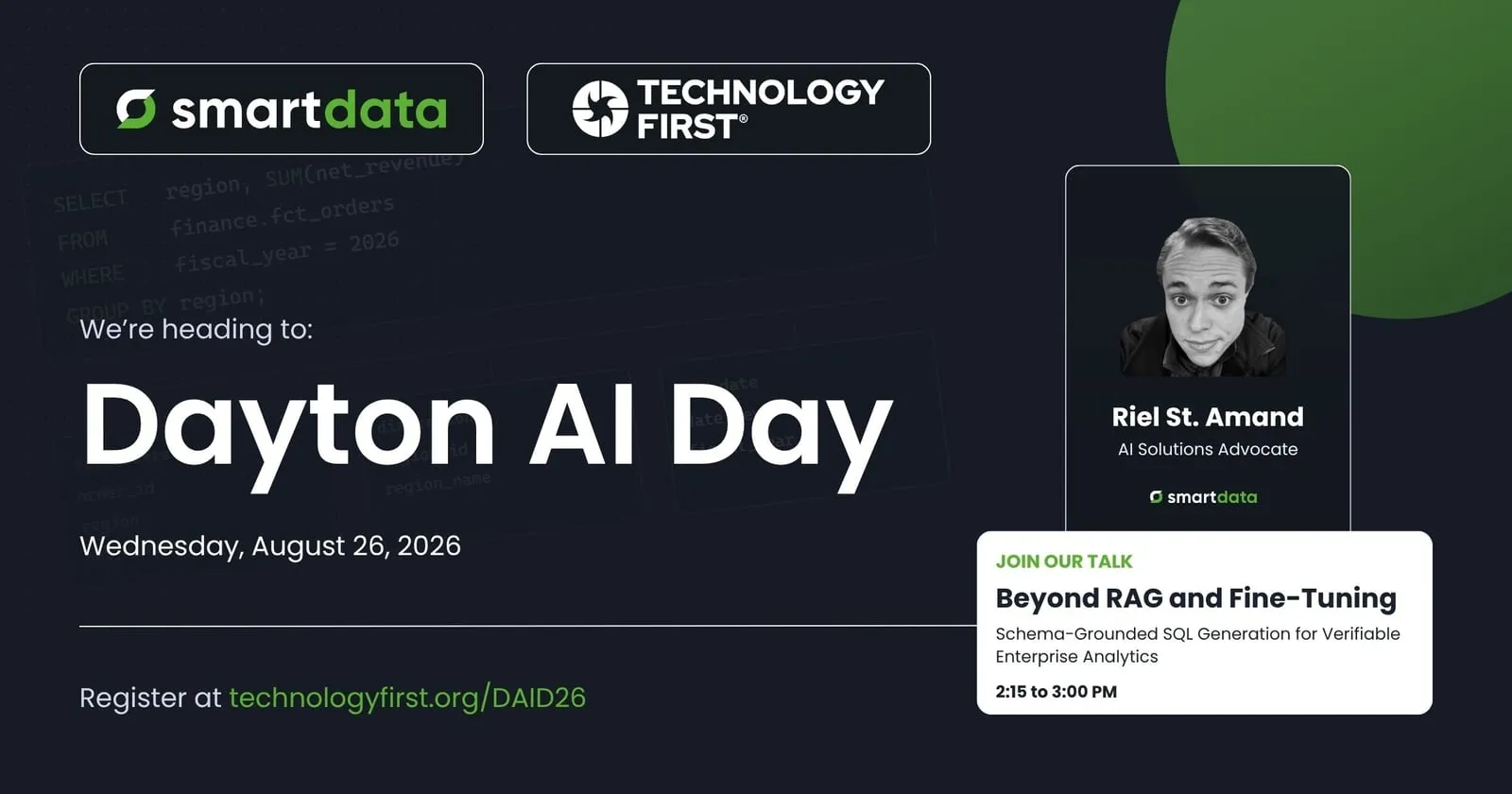
Smart Data took part in Technology First’s 2026 Dayton AI Day on Wednesday, August 26 at 1435 Cincinnati Street in Dayton.
The day brought together data and technology leaders across the Miami Valley who are working through exactly that shift. The conversations we’re in most often start the same way. Someone has been asked how their organization is going to use AI, and the honest answer depends on whether the data underneath can support it. That’s where our work sits: data platforms on Microsoft Fabric, Databricks and Snowflake, and the governance and quality practices that keep the answers trustworthy once people start making decisions on them.
Speaking Session
Beyond RAG and Fine-Tuning: Schema-Grounded SQL Generation for Verifiable Enterprise Analytics
Session 4 | 2:15 to 3:00 PM
Speaker: Riel St. Amand, AI Solutions Architect, Smart Data
Most enterprise AI pilots pass the demo and fail the audit. The data worth asking questions about lives in warehouses and schemas, but standard approaches to putting a language model in front of it were built for documents, leaving you without a way to prove the answer you got back is correct.
Riel walked through what it takes to get real analytics out of structured enterprise data while architecting out hallucination and runaway compute costs, rather than monitoring for them after the fact. The talk covered:
- Where RAG and fine-tuning break down on structured enterprise data
- How schema grounding constrains the model so the output can be verified
- Keeping compute costs from scaling quietly in the background
- What this looks like against real enterprise data rather than benchmarks
About the speaker
Riel St. Amand is an AI Solutions Architect at Smart Data, where, in his words, he helps “clients evaluate AI use cases and build reliable systems around them.” Outside of client work, he builds and maintains several public software projects, including Tokens or Towers, a tool for comparing hosted AI costs against local hardware, and ChartLite, a charting library for AI-assisted development.
Verifiable output, in practice
Verifiable output is not an abstract concern for us. On a recent engagement with a major national retailer, our team built an AI-assisted migration tool that converted a legacy ETL estate into Databricks pipelines and generated unit tests and infrastructure as code with every conversion, so the client’s platform team could check the output rather than take it on faith. The tool handled roughly 78 percent of the legacy transformation types, and the first phase landed in about three months against a manual alternative scoped at multiple teams over multiple years. Read the full case study here.
That is the same principle Riel spoke to: AI is only useful in production when someone can prove the answer is right.
Event Details
2026 Dayton AI Day 📅 Wednesday, August 26 📍 1435 Cincinnati Street, Dayton, Ohio
If you lead data or AI strategy in the Dayton area, we’d rather hear what you’re trying to get working than pitch anything.
If you missed it
The question Riel answered on stage is the same one we start with in an AI Readiness Workshop. Whether your data is in a shape where AI can give you answers you can stand behind. It is a fixed-scope look at what you have, what is missing and what a realistic first use case looks like.